Get Free Ebook Coders at Work: Reflections on the Craft of Programming
Why should be so complicated when you can really get guide to check out in far better way? This book is constantly the initial referred publication to check out. When we offer Coders At Work: Reflections On The Craft Of Programming, it means that you remain in the ideal site. This is a very representative book to get after for long period of time you don't discover this specific publication. Connected to your issue, requirement, and also related to just what your favourite product to read currently, this book can be actually reference.
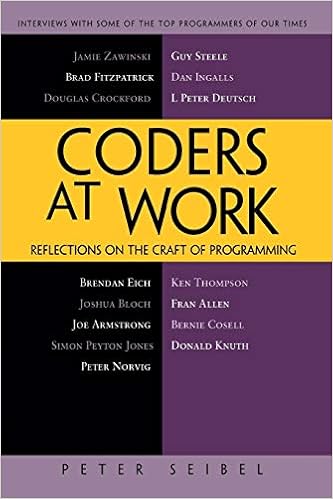
Coders at Work: Reflections on the Craft of Programming

Get Free Ebook Coders at Work: Reflections on the Craft of Programming
New updated! The Coders At Work: Reflections On The Craft Of Programming from the very best author and also author is now readily available right here. This is guide Coders At Work: Reflections On The Craft Of Programming that will certainly make your day checking out ends up being finished. When you are seeking the printed book Coders At Work: Reflections On The Craft Of Programming of this title in guide store, you might not find it. The troubles can be the limited versions Coders At Work: Reflections On The Craft Of Programming that are given up the book store.
But, just what's your concern not also liked reading Coders At Work: Reflections On The Craft Of Programming It is a fantastic activity that will consistently offer excellent advantages. Why you end up being so odd of it? Several points can be sensible why people do not prefer to review Coders At Work: Reflections On The Craft Of Programming It can be the uninteresting tasks, guide Coders At Work: Reflections On The Craft Of Programming compilations to read, also careless to bring nooks almost everywhere. Now, for this Coders At Work: Reflections On The Craft Of Programming, you will start to enjoy reading. Why? Do you understand why? Read this web page by completed.
As the other publication will certainly offer, besides the brand-new lesson it will likewise improve the impact and also inspirations associated with this subject. We're truly sure that your selection to select as analysis book will be not incorrect. It thinks that the presence of the book will enrich this world's literary collections. When many people search for this subject for guide analysis, it will certainly come to be the one that influence you making new inspirations.
After obtaining the soft file, you can conveniently develop brand-new motivations in your mind. It is challenging to get the book in your city, probably furthermore by seeing the store. Checking out the shop will not additionally give assurance to get the book? So, why do not you take Coders At Work: Reflections On The Craft Of Programming in this website? Also that's only the soft documents; you can truly feel that guide will certainly be so beneficial for you as well as life about.
About the Author
Peter Seibel is a serious developer of long standing. In the early days of the Web, he hacked Perl for Mother Jones and Organic Online. He participated in the Java revolution as an early employee at WebLogic which, after its acquisition by BEA, became the cornerstone of the latter's rapid growth in the J2EE sphere. He has also taught Java programming at UC Berkeley Extension. He is the author of Practical Common LISP from Apress.
Read more
Product details
Paperback: 632 pages
Publisher: Apress; 1st ed. edition (September 16, 2009)
Language: English
ISBN-10: 9781430219484
ISBN-13: 978-1430219484
ASIN: 1430219483
Product Dimensions:
7 x 1.4 x 10 inches
Shipping Weight: 2.8 pounds (View shipping rates and policies)
Average Customer Review:
4.3 out of 5 stars
89 customer reviews
Amazon Best Sellers Rank:
#173,969 in Books (See Top 100 in Books)
I really like this book for the feeling that these people who have accomplished so much are just like me and do not do anything insane to achieve what they have. Many of their stories are like my own.Sometimes we take the leaders of an industry and blow their importance and worth out of proportion: "Only THEY could have done it." That doesn't make their accomplishment any lesser and I like that this book shows the humanity that hides behind code and products they've built.
Despite the title, which uses the term "coder" to describe the software developer, this 600-page series of 15 interviews by Seibel is actually quite fascinating. In the words of the author, the questions he posed to these accomplished software developers are varied, revolving around "how they learned to do it, what they've discovered along the way, and what they think about its future". While these were some of the questions asked of all interviewees, like any good journalist Seibel used these as starter questions, going on unique tangents for each along the way. This reviewer noticed that several readers had expected some type of how-to guide by each individual interviewed, but the content here is composed of discussion points, as the subtitle suggests. If you enjoy interviews in the software space, such as those that one might regularly find on InfoQ, you will probably enjoy this collection.Though weighty, there are numerous great sound bites throughout. Jamie Zawinski, "one of the prime movers behind [...], the organization that took the Netscape browser open source", is quoted as saying "I hope I don't sound like I'm saying, 'Testing is for chumps.' It's not. It's a matter of priorities. Are you trying to write good software or are you trying to be done by next week? You can't do both. One of the jokes we made at Netscape a lot was, 'We're absolutely 100 percent committed to quality. We're going to ship the highest-quality product we can on March 31st." Seibel poses the following question to Douglas Crockford, inventor of JSON: "In one of your talks you quoted Exodus 23:10 and 11: 'And six years thou shalt sow thy land, and shalt gather in the fruits thereof: But the seventh year thou shalt let it rest and lie still' and suggested that every seventh sprint should be spent cleaning up code. What is the right time frame for that?" To which Crockford replies: "Six cycles - whatever the cycle is between when you ship something. If you're on a monthly delivery cycle then I think every half year you should skip a cycle and just spend time cleaning the code up."Brendan Eich, creator of JavaScript, later comments: "Abstraction is powerful. What I'm really allergic to, and what I had a bad reaction to in the '90s, was all the CORBA, COM, DCOM, object-oriented nonsense. Every startup of the day had some crazy thing that would take 200,000 method calls to start up and print 'hello, world'. That's a travesty; you don't want to be a programmer associated with that sort of thing. At SGI, the kernel, of course, was where the real programmers with chest hair went, and there you couldn't screw around. Kernel malloc was a new thing; we still used fixed-sized tables, and we panicked when we filled them up. Staying close to the metal was my way of keeping honest and avoiding the bulls***, but now, you know, with time and better, faster hardware and an evolutionary winnowing process of good abstractions versus bad, I think people can operate above that level and not know assembly and still be good programmers and write tight code."Joshua Bloch, Chief Java Architect at Google at the time this book was written, comments that "there's this problem, which is, programming is so much of an intellectual meritocracy and often these people are the smartest people in the organization; therefore they figure they should be allowed to make all the decisions. But merely the fact that they're the smartest people in the organization doesn't mean they should be making all the decisions, because intelligence is not a scalar quantity; it's a vector quantity. And if you lack empathy or emotional intelligence, then you shouldn't be designing APIs or GUIs or languages. What we're doing is an aesthetic pursuit. It involves craftsmanship as well as mathematics and it involves people skills and prose skills - all of these things that we don't necessarily think of as engineering but without which I don't think you'll ever be a really good engineer."Summarized as the "mother" of Smalltalk (the counterpart to Alan Kay, the "father" of Smalltalk), Dan Ingalls comments that "people should learn to think clearly and to question. And to me it's very basic. If you grow up in a family where when the cupboard door doesn't close right, somebody opens it up and looks at the hinge and sees that a screw is loose and therefore it's hanging this way vs. if they say, 'Oh, the door doesn't work right; call somebody' - there's a difference there. To me you don't need any involvement with computers to have that experience of what you see isn't right, what do you do? Inquire. Look. And then if you see the problem, how do you fix it? To me it's so basic and human and comes so much from parent to child. Computers are certainly a medium for doing that. But they're just computers. There's a lot of that that will transfer, but to me it's really big and basic and human, so it's not like we're going to enlighten the world just by teaching them computers."
This book is just a bunch of interviews with some programmers you might recognize and some you may not. It seems to be pretty lightly edited and some people may find some sections boring (and others may not)! "Coders at Work" is a fascinating insight into the education, careers and minds of some pretty big names in the field. I ordered the book before reading some of the negative reviews and I'm very glad I did. I almost hesitated to start reading it thinking that it was going to be boring and dry but it wasn't. Yes, there is definitely heavy use of acronyms and terms that I wasn't familiar with but to me it was a learning opportunity and a chance to dig a little deeper to figure out what the interviewees were talking about.It's tough to predict if this book will appeal to you. If you're a seasoned software industry professional with a deep love for the 'craft' of coding then you'll love this collection if interviews. I certainly did and it reminded me of why I got into this industry in the first place and it rekindled a love for coding.
This book is an enjoyable collection of interviews of some well known personalities in the computer industry. These interviews run the gamut of topics: understanding programs, writing code, how programmers view themselves, and working with others to name a few. However, the most fantastic thing about the viewpoints is this: they differ.The diversity of approaches, mindset, attitude, and execution of each of the coders interviewed is a welcome change from the onslaught of the "best practices" mindset which has become increasingly popular in recent years. Even more amazing is the levels of success that they have achieved in spite of (or perhaps, because of) their differences.While some would find the repetition of questions or extended stories regarding the history of each coder yawn-inducing, I found it to be a refreshing break from the standard computer book fare. If you want to learn about a specific language, platform, or development process, you will want to buy a different book; it covers these topics in only the broadest sense.My only gripes are minor: first, there are a surprising amount of typos. Second, the book tends to drag when Seibel does more of the talking than the interviewee. Thankfully, this doesn't happen often.Ultimately, it is a good collection of opinions and war stories which will broaden your perspective towards code and people who write it.
Coders at Work: Reflections on the Craft of Programming PDF
Coders at Work: Reflections on the Craft of Programming EPub
Coders at Work: Reflections on the Craft of Programming Doc
Coders at Work: Reflections on the Craft of Programming iBooks
Coders at Work: Reflections on the Craft of Programming rtf
Coders at Work: Reflections on the Craft of Programming Mobipocket
Coders at Work: Reflections on the Craft of Programming Kindle

0 comments: