PDF Ebook Moral, Believing Animals: Human Personhood and Culture
Taking into consideration about the perfections will require certain truths as well as sights from some resources. Now we offer Moral, Believing Animals: Human Personhood And Culture as one of the sources to think about. You might not forget that publication is the most effective source to resolve your problem. It can help you from several sides. When having such problem, getting the best publication is much needed. It is to make offer as well as matched to the problem as well as the best ways to resolve it.
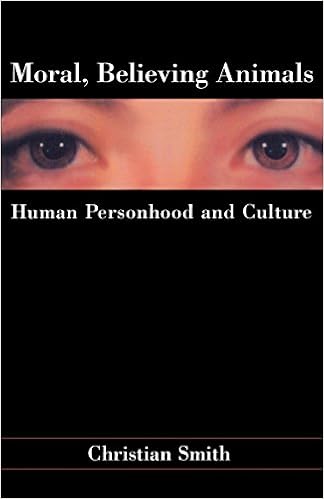
Moral, Believing Animals: Human Personhood and Culture

PDF Ebook Moral, Believing Animals: Human Personhood and Culture
How if there is a website that enables you to search for referred publication Moral, Believing Animals: Human Personhood And Culture from all over the globe author? Immediately, the site will be astonishing completed. Many book collections can be located. All will be so very easy without challenging point to move from website to website to obtain the book Moral, Believing Animals: Human Personhood And Culture really wanted. This is the site that will offer you those assumptions. By following this website you could get great deals numbers of book Moral, Believing Animals: Human Personhood And Culture compilations from variations kinds of author and also publisher preferred in this globe. Guide such as Moral, Believing Animals: Human Personhood And Culture as well as others can be gained by clicking good on web link download.
We understand that you are likewise fan of the author of this book. So, it will not be even worse for you to select it as recommendation. Moral, Believing Animals: Human Personhood And Culture, as one of the crucial books to read can be taken into consideration as a book that gives you something recommended. You can take the similar topic from other publication, but the one that could give you far better impact is this book. This problem will truly affect you to serve the reputable choice.
We provide the book is based upon the reasons that will certainly influence you to live much better. Even you have already the analysis book; you can additionally improve the understanding by obtaining them form Moral, Believing Animals: Human Personhood And Culture This is actually a type of publication that not just provides the inspirations. The remarkable lessons, Experiences, and expertise can be gained. It is why you should read this book, even web page by web page to the finish.
When presenting Moral, Believing Animals: Human Personhood And Culture as one of the collections of lots of books right here, we presume that it can be one of the most effective publications provided. It will have numerous fans from all countries visitors. And also precisely, this is it. You could really disclose that this publication is just what we assumed at first. Well currently, let's seek for the other publication title if you have got this book review. You could find it on the search column that we give.
Review
"Well written and clearly argued, Moral Believing Animals is both a searching critique of recent social theory and an important first step toward the articulation of a richer model of human personhood, motivation, and culture." --INSight"A concise book that is enjoyable and easy to read, offering a far-reaching synthesis of a variety of philosophical and sociological approaches.... Smith masterfully situates many of the key current debates while calling attention to their historical origins and implicit assumptions." --Contemporary Sociology"An admirable model of wide-ranging and rich yet focused scholarship." --The Journal for the Scientific Study of Religion
Read more
About the Author
William R. Kenan, Jr. Professor of Sociology and Director of the Center for the Study of Religion and Society at the University of Notre Dame
Read more
Product details
Paperback: 172 pages
Publisher: Oxford University Press; 1 edition (August 26, 2009)
Language: English
ISBN-10: 0199731977
ISBN-13: 978-0199731978
Product Dimensions:
8.5 x 0.4 x 5.4 inches
Shipping Weight: 10.1 ounces (View shipping rates and policies)
Average Customer Review:
3.9 out of 5 stars
6 customer reviews
Amazon Best Sellers Rank:
#690,632 in Books (See Top 100 in Books)
I come belatedly to this account. To be human is to be a moral, believing animal, involved in a narrative, That applies to secularists too. He probes a wide range of contemporary accounts without discovering a satisfying explanation for motivation. But read on for his proposal .......!
Excellent sociology
Sociologists have been waiting a long timefor something like this. Though the sociologyof religion has come a long way, works thatunpack the religious and philosophicalassumptions of sociology have been fewand far between. Besides Peter Berger's Rumorof Angels and Robert Bellah's Beyond Belief,I'm not sure that anything comes as close asMoral, Believing Animals in laying the groundworkfor a dialogue between religion and social science.
This book represents the first attempt of one of the leading minds in the sociology of religion to address the question of what exactly are human persons - one of the central units of analysis in the study of society. With the obvious nod to Alasdair MacIntyre (and his work Moral Reasoning Animals), Smith points out how central to any concept of the human person is the recognition that we are, as the title intimates, moral (in that we have a sense of there being right and wrong things, actions, etc. -though that doesn't mean we share similar moral content!) and believing (ideas and concepts fill and shape the way we view our world). With that in mind, Smith than looks at the consequences of this for how we view motivations, narratives, culture, etc.This thought provoking work should be viewed as an important transition point from Smith's early substantive work on religion, motivations, and action (Resisting Reagan and the Emergence of Liberation Theology) as well as his work on beliefs, culture and collective identity (American Evangelicalism) toward his most recent tome that draws a more complete and complex picture of the human person (What is a Person?).
I read this book for a Sociology capstone class and found it very interesting. Smith writes in an understandable way and presents his theory in an organized way. I really like his theory of personhood.
I must say this author Christian Smith is the gift that keeps on giving. It is often very hard to sum up the misunderstandings and essentially anti-intellectual propaganda surrounding errors of interpretation involving the Enlightenment. It is easy to do it with Evangelicals on TV, like the 700 club who are regularly so obsessed with the "Illuminati" that they imagine they are still around somewhere hiding behind a bush. The "Illuminati" are a paranoid symbol for a huge caricature of the Enlightenment's intents that they find objectionable. So objectionable that it would seem to cancel out collaterally the very founding notions of the United States. But, no matter, they continue in their obsessions. By contrast, there seems to be a whole realm of academics, often Catholics but not always, who are dedicated to trying to eviscerate any real real critical power from the Enlightenment ethos, and re-establish rationality in a context more akin to unchanging religious dogma. But it is a rather slippery affair with these folks. Unlike the sometime anti-intellectualism of the Evangelicals, these crypto-anti-intellectuals want to use intellectual matters themselves to do it. And it must be admitted that they have a long tradition in Western culture in their corner. And they are welcome to it. No one sane disputes their right to busy themselves with their long tradition. But it is quite another thing for these people to be involved essentially in intellectual skullduggery and manifestly thuggish hit jobs against the very basis of modern societies -- the Enlightenment. Well sadly that is exactly what one finds in this book. But more broadly this book is proof yet again that scholarly elaboration in our modern era has entered into some sort of surreal nether- world, akin somehow to the proverbial "tree that falls in the forest with no one there to hear it." Intellectuals as a group must accept the rather humbling prospect that the readership of their efforts is, apparently statistically zero. Perhaps I am aping chicken-little in this observation, but this book gives me cause. For it not only contains a completely false summary of the character of the Enlightenment, but it supports this caricatured falsehood with two sources, in a footnote, that say the EXACT OPPOSITE of what this fanciful author is using them for support for. So what other explanation that the thing got published, except that no one read it, to say nothing of critically editing or fact-checking it. The author claims that a chief desideratum of the Enlightenment was to create a new "authoritative" sense of things detached from traditional religion and aiming in the direction of the non-theistic, and we can assume he means broadly scientific as well. But this poor man seems to have a children's book notion of what the whole epochal transformation was about. For first the entire thrust of Enlightenment epistemology involved a critique of of "authoritative" matters per se. This is pretty basic. Really, one almost feels silly waxing specific about such a basic thing, and better to just say "Duh!" to the silly contention. But even worse. This author has the negativized chutzpah to actually try to support this false notion with two sources, Byrnes and Outram, which are very fine works, but filled with everything in contrast to this false notion. Byrnes actually emphasizes the continued weaving-through of THEISTIC notions all throughout the period, which is exactly what you would expect from a non-propagandized source interested in getting the intellectual history right, Even stranger is the use of Outram who actually provides critique of fairly recent scholarly views that overly-simplify notions of the Enlightenment. Amazingly, the notions she critiques are in fact contiguous with the very falsehood the Christian Smith is putting forth. That takes some sort of gall or self-delusion to actually use a source which in fact totally, cumulative, and even specifically contradicts you, and pretend that it gave support. Breathtaking! Of course the author puts forth this falsehood because he has a larger objective. Namely, to provide the groundwork for a broader interpretation, and it is a doozy. In this case it is a mode of attack so silly it almost defies serious description. The noble critical heights of the Enlightenment are reduced to a "narrative" which we got wrong, and eventually related to even more fantastically elaborated notions. For instance, that this "narrative" was involved with supposedly critiquing the idea that in the past everyone was huddled a round a fire in mythic ignorance, and now, with this sociologist's help, we are assisted in dispelling the hubris of our Enlightenment "narrative' and seeing that we are all just huddled around our televisions-- so we shouldn't get so uppity in our Enlightenment critiques!! It is really impossible to plumb this fatuousness of this approach adequately. But at least we can quickly tell why it is all happening in the book, because the author enunciates his belief, which appears again in his recent woks, that nothing new will be offered. He is here to just shore up ancient sureties, regardless of what took place intellectually and culturally in the intervening centuries. On a personal note, I can say that it is all very consistent with the very worst of the academic profession I encountered in the very Catholic realm of seminary training. That is how I recognize this whole essentially dogmatic Catholic so thoroughly. It brings back tawdry memories. Fortunately for me, I had, by contrast, some of the best of that field too. Like Charles Curran, who as the opposite from this in trying to honestly deal with history, and still very committed to the faith. But as to this terrible book, what is proves more than anything else, is that we seem to entered the intellectual "tree that falls in the forest" age. That such glaring falsehoods could exist in a seriously published work has no other serious explanation. Except that no body notices, and nobody cares. Very sad for all of us.
Moral, Believing Animals: Human Personhood and Culture PDF
Moral, Believing Animals: Human Personhood and Culture EPub
Moral, Believing Animals: Human Personhood and Culture Doc
Moral, Believing Animals: Human Personhood and Culture iBooks
Moral, Believing Animals: Human Personhood and Culture rtf
Moral, Believing Animals: Human Personhood and Culture Mobipocket
Moral, Believing Animals: Human Personhood and Culture Kindle

0 comments: